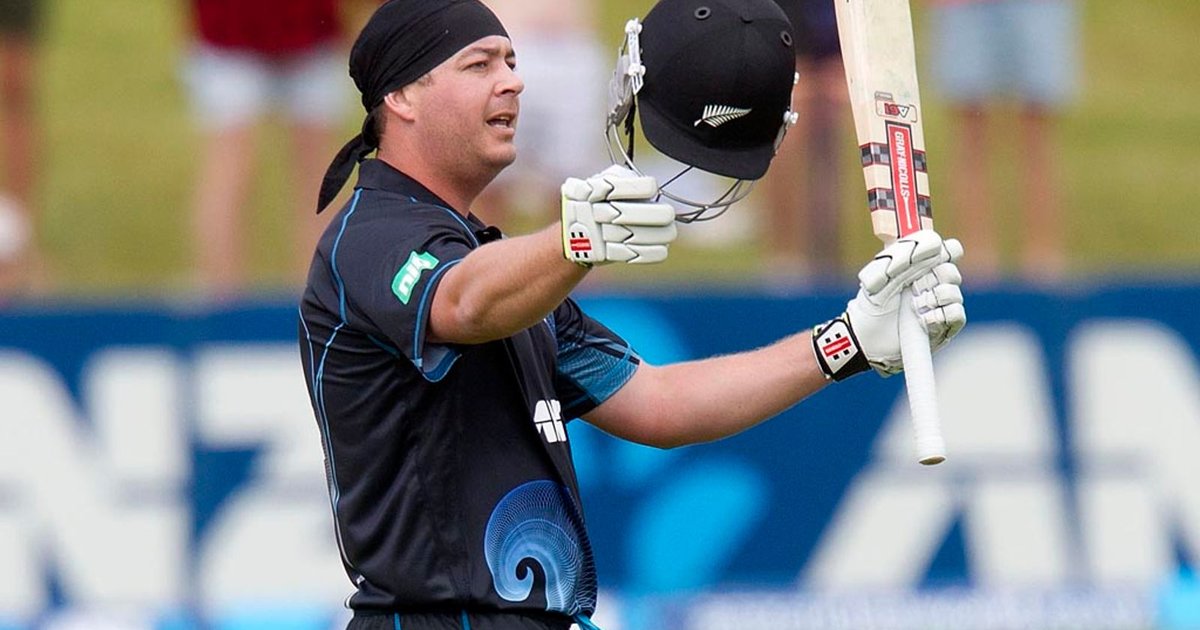
Some cricketers are remembered for what they won. Jesse Ryder is remembered for what New Zealand never got to see the end of.
Even now, the name alone does something. Say Jesse Ryder to anyone who watched New Zealand cricket in that era and you don't get a shrug, you get a story, usually told with a mix of admiration and regret. Few players in the modern game carry that much weight in two words without a single ICC trophy to their name.
For a few years in the late 2000s, Ryder was one of the most destructive left-handed batsmen in world cricket, a player good judges compared to the very best of his generation. Then, one incident at a time, that career kept getting interrupted, until eventually it just stopped. Not because the talent ran out. It never did.
The Talent Was Never in Question
Ryder made his ODI debut for New Zealand on 9 February 2008 and his Test debut that December, against India in Ahmedabad. He batted left-handed in the middle order with a game built on power rather than caution: a short-arm pull that arrived from nowhere, a flick off the hip that turned good-length balls into boundaries, and the kind of bat speed that made bowlers change their plans mid-over.
He also bowled useful right-arm medium pace, which made him a genuine all-round threat rather than a specialist batter carrying a reputation. Team-mates and opposition alike said the same thing about him in those early years: on his day, there was no bowling attack in the world he couldn't take apart.
The Innings That Announced Him
That potential turned into proof on 27 March 2009, in the second Test against India at Napier. New Zealand batted first and kept batting. Ryder built an innings of 201, sharing a stand of 121 with James Franklin and another 62 with Brendon McCullum, who made 115 at the other end. New Zealand declared at 619 for 9, one of the biggest totals in their Test history, with Ryder's double century as its foundation.
It remains one of the great what-could-have-been innings in New Zealand cricket: proof, in black and white in the scorebook, of exactly what Ryder was capable of when everything lined up.
The Pattern Beneath the Talent
The trouble had already started before that innings, and it kept recurring after it. On 24 February 2008, Ryder badly cut his hand trying to break into a toilet at a Christchurch bar in the early hours of the morning, severing tendons and ruling himself out of cricket for three months. In January 2009, he missed a team meeting and training session, and was subsequently left out of an ODI against the West Indies, after a late night out.
None of these were career-ending on their own. Taken together, they formed a pattern selectors and team management couldn't ignore: a player capable of match-winning brilliance, whose off-field discipline kept undoing the good the bat was doing.
The Sabbatical, and the Night That Nearly Ended Everything
In 2012, Ryder stepped away from international cricket, saying the demands of the job had become too much psychologically and emotionally to manage. It read, at the time, like a player choosing his own wellbeing over his career. It looked prophetic a year later.
In March 2013, Ryder was assaulted outside a bar in Christchurch. He suffered a fractured skull and severe internal injuries and was placed in a medically induced coma. He was also, separately, banned for six months after testing positive for a banned substance, which the New Zealand Sports Tribunal later ruled he had taken unwittingly, as part of a weight-loss supplement. The assault had nothing to do with his cricket, and everything to do with the surroundings a young, troubled athlete without enough structure around him kept finding himself in.
Sobriety, and a Door That Never Reopened
Ryder got sober in 2014, a fact he has spoken about with more pride than almost anything he achieved with the bat. He tried to come back. He spent two years performing at domestic level, by his own account dominating Plunket Shield and one-day cricket, and believing he was good enough to be one of the best batters in the world again. The Black Caps recall never came. His last international appearances, an ODI and a T20I, were both in 2014. He joined Essex in county cricket that same year and continued playing domestic and franchise cricket for several more seasons before retiring from professional cricket in 2018.
His final numbers still make the case for what was lost: 1,269 Test runs at 40.93 from 18 matches, 1,362 ODI runs at 33.21 from 48 matches, and 22 T20I appearances, all compiled by a player who never got the sustained run in the side that his ability deserved.
What the Story Actually Teaches
It's tempting to file Jesse Ryder under cricket's long list of wasted talents and leave it there. That misses the more useful lesson. Ryder wasn't short of skill, application on the field, or big-match temperament, he proved all three at Napier and elsewhere. What derailed him were the parts of professional sport that never show up on a scorecard: the pressure, the isolation, the absence of support systems built to catch a young player before a bad night becomes a pattern, and a pattern becomes a lost career.
That's as true in a backyard net in Coimbatore as it is in an international dressing room. Talent gets a player noticed. What happens around that talent, the structure, the people, the support, decides how much of it the game actually gets to see.
Also read: How to Mentally Prepare to Lead a Cricket Team, on the psychological side of the game that talent alone was never going to cover.
Think you know your cricket legends? Guess the Legend is a new cricketer every day — six clues, six guesses.